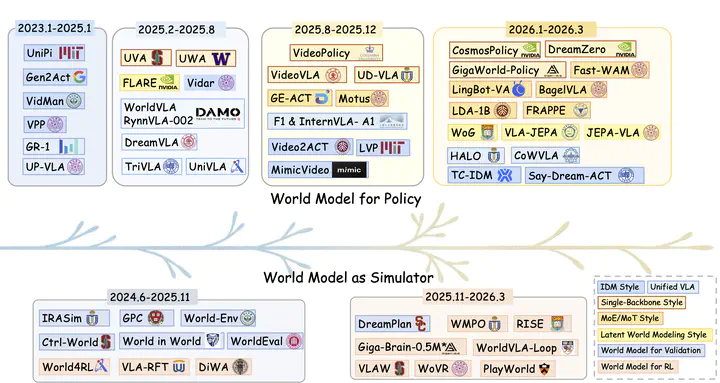
Abstract
World models, which are predictive representations of how environments evolve under actions, have become a central component of robot learning. They support policy learning, planning, simulation, evaluation, data generation, and have advanced rapidly with the rise of foundation models and largescale video generation. However, the literature remains fragmented across architectures, functional roles, and embodied application domains. To address this gap, we present a comprehensive review of world models from a robot-learning perspective. We examine how world models are coupled with robot policies, how they serve as learned simulators for reinforcement learning and evaluation, and how robotic video world models have progressed from imagination-based generation to controllable, structured, and foundation-scale formulations. We further connect these ideas to navigation and autonomous driving, and summarize representative datasets, benchmarks, and evaluation protocols. Overall, this survey systematically reviews the rapidly growing literature on world models for robot learning, clarifies key paradigms and applications, and highlights major challenges and future directions for predictive modeling in embodied agents.